
PinPoint™
More Than 300 Days of Grazing
Every day cattle harvest their own forage is another day producers spend less on stored or purchased feed. Yet across much of the United States, cattle graze for an average of only seven months each year. For the remaining five months, producers often rely on hay, silage, baleage, supplements, and other costly feed sources.
PinPoint™ is Barenbrug’s integrated forage system designed to help producers extend grazing beyond 300 days a year. By combining productive perennial pastures, seasonal forage crops, legumes, and effective grazing management, PinPoint™ helps fill predictable forage gaps, reduce feed expenses, and improve the profitability of livestock operations.
Lower Feed Costs by Grazing Longer

Feed harvested directly by livestock is almost always less expensive than preserved forage. Hay, silage, and baleage require equipment, fuel, labor, storage, and transportation. Grazing allows cattle to harvest their own feed while returning nutrients directly to the pasture.
Winter feed is often one of the largest expenses in a cattle operation. Reducing the hay-feeding season by even a few weeks can create meaningful savings.
PinPoint™ products can help producers reduce feed costs, improve pasture utilization, and maintain a more consistent forage supply throughout the year. Depending on forage costs, growing conditions, and management, PinPoint™ products can provide savings of up to $48.60 per cow compared with feeding hay.
Hay is costing me 3 cents a pound to produce and I have to haul it to the cattle. Brassicas are costing me less than a cent to plant, and the cattle harvest it. I can't afford not to plant it!
Dustin Cross, Columbia County, Arkansas
How PinPoint™ Works
Forage does not grow evenly throughout the year. Cool-season grasses slow down during summer heat, while warm-season grasses produce little growth during colder months. Even well-managed pastures experience periods of shortage.
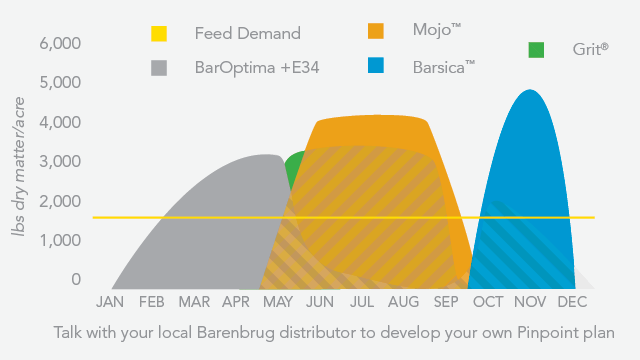
Rather than relying on one forage to perform year-round, PinPoint™ combines perennial pastures with strategically planted seasonal crops so that when one forage slows down, another is reaching peak production.
- Productive perennial grasses provide the long-term foundation of the pasture.
- Legumes improve forage quality while naturally supplying nitrogen to neighboring grasses, reducing fertilizer needs.
- Warm-season annuals fill summer grazing and hay shortages.
- Annual ryegrasses provide forage during winter and early spring.
- Stockpiled tall fescue (fall growth left standing for winter grazing) provides dependable forage after active growth slows.
This approach allows producers to plan for seasonal shortages before they occur while better matching forage supply with livestock demand.
PinPoint™ works best as part of a broader management strategy that includes productive perennial pastures, narrow calving periods aligned with the local environment, stockpiled forage, and timely planting of seasonal crops.
PinPoint™ by Season
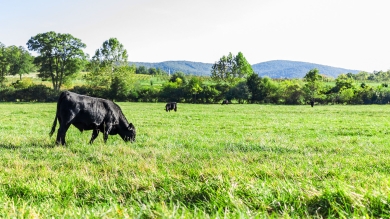
Start with a Strong Perennial Base
A successful grazing system begins with productive perennial pastures adapted to the region.
In the transition zone, BarOptima® E34® | Get Plus® provides a persistent, animal-safe tall fescue foundation.
In cooler regions, producers can use improved cool-season grasses such as:
- STF-43 | Get Plus®, our soft-leaf tall fescue blend
- BG®-24T | Get Plus®, our perennial ryegrass blend
- HLR™, our late-maturing orchardgrass blend
In warm-season regions, Grit®, our Bermudagrass blend, provides a persistent base for grazing and hay production.
Perennial grasses provide the backbone of the pasture, but they perform even better when paired with legumes. Clovers and other legumes should also be considered in an improved pasture plan. In addition to increasing crude protein and improving forage quality, legumes naturally capture nitrogen from the atmosphere and supply it to neighboring grasses, helping reduce fertilizer costs. Different species and varieties can be selected to fit specific soils, climates, and livestock systems.
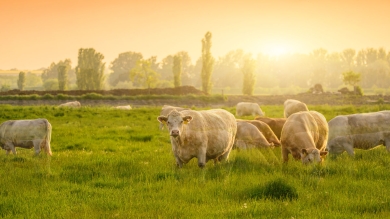
Fill the Summer Slump
Cool-season grass growth can slow significantly during hot summer weather. Planting warm-season annuals in late spring helps producers prepare for this predictable forage shortage.
- Mojo™, our forage crabgrass, provides palatable summer grazing and can be planted as a dedicated stand or interseeded into existing pastures. Under favorable conditions, it can be ready for its first grazing approximately six weeks after planting.
- Moxie™, our premium teff blend, provides dependable summer hay production. It can produce multiple cuttings of quality forage and may be ready for its first cutting approximately six weeks after planting. Because teff has a shallow root system, Moxie™ is best suited for hay rather than grazing.
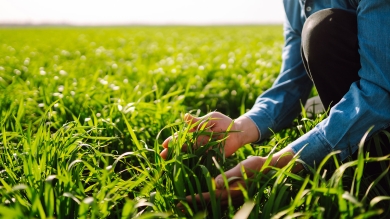
Use Stockpiled Fescue
Stockpiled fescue is simply tall fescue that is left standing in the pasture instead of being harvested as hay. Rather than cutting, baling, storing, and feeding forage later, producers allow cattle to graze it directly during late fall and winter. In effect, the pasture becomes the storage barn.
Although stockpiling may be unfamiliar to some producers, using accumulated fall fescue during late autumn and winter has repeatedly been shown to help maintain livestock profitability.
Successful stockpiling generally requires producers to:
- Remove livestock from selected fields before fall growth begins.
- Allow forage to accumulate without grazing.
- Use strip grazing, where temporary fencing gives livestock access to only a small section of pasture at a time, to improve forage utilization and reduce waste.
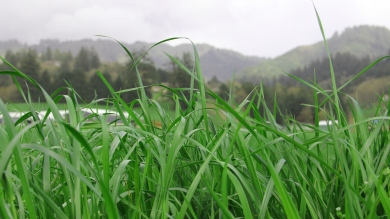
Add Winter and Spring Forage
Annual ryegrass is planted in the fall and grows rapidly through winter and early spring. It fills the gap between dormant warm-season pastures and spring green-up, providing abundant, highly digestible forage when many perennial pastures are producing little growth.
- Maximus™, our tetraploid annual ryegrass, is early maturing and highly winter active. It is especially useful in regions where Bermudagrass greens up earlier in spring because it provides winter grazing without significantly competing with the Bermudagrass growing season.
- Green Spirit®, our Italian ryegrass blend, provides high yields of quality forage and a longer cool-season grazing window.
- Jumbo™ can also be overseeded into dormant Bermudagrass where a longer spring production period is desired.
PinPoint™ by Region
Transition Zone
The transition zone has summers that are often too hot and humid for dependable cool-season grass production and winters that are too cold for year-round warm-season grass growth.
BarOptima®E34® | Get Plus® provides a persistent, animal-safe tall fescue foundation for this region.
Incorporating adapted legumes, such as clovers, into perennial pastures can improve forage quality while naturally supplying nitrogen to neighboring grasses, helping reduce fertilizer costs.
In late spring, Mojo™ can be planted for summer grazing, while Moxie™ can be planted for summer hay production. These warm-season annuals help prepare for the decline in cool-season grass growth during hot weather.
Finally, Green Spirit® can be planted in fall to provide high yields of quality forage throughout winter and into spring.
Cool Season Region
Cool-season regions rely primarily on grasses that produce most actively during spring and fall.
Producers should establish well-adapted improved varieties such as STF-43 | Get Plus®, BG®-24T | Get Plus®, or HLR™ as the perennial pasture foundation.
Adapted legumes, such as clovers, can be incorporated into these perennial pastures to improve forage quality while naturally supplying nitrogen to neighboring grasses.
When summer heat slows cool-season grass growth, Mojo™ can provide grazing by being planted in late spring in preparation for the summer shortfall.
Finally, Green Spirit® can be planted in fall to provide additional high-quality forage throughout winter and spring.
Warm Season Region
Warm-season regions rely on persistent perennial grasses such as Bermudagrass and bahiagrass. Most annual forage production occurs during late spring and summer, with limited growth during early spring, late fall, and winter.
Grit® provides a persistent Bermudagrass foundation for grazing and hay production. Where appropriate, legumes can also be incorporated to improve forage quality while naturally contributing nitrogen to the pasture system.
Because warm-season perennial grasses produce most actively during summer, additional warm-season annuals are generally less important than in cooler regions.
Finally, Maximus™ is well suited for regions where Bermudagrass greens up earlier in spring. Its early maturity and strong winter activity provide cold-season grazing while reducing competition with the Bermudagrass production period. Maximus™ can be overseeded in late fall into established Grit® Bermudagrass pastures.
In regions where Bermudagrass remains dormant longer and does not green up until late spring or early summer, Jumbo™ or Green Spirit® can be overseeded into Bermudagrass pastures.
Build Your 300-Day Grazing System
PinPoint™ is a flexible forage system built around one simple idea: use the right forage at the right time. By combining productive perennial pastures with seasonal annuals, legumes, brassicas, stockpiled forage, and sound grazing management, producers can keep livestock grazing longer, reduce feed costs, and improve the profitability of their operation.
Explore the PinPoint™ product family or contact your local Barenbrug representative to develop a forage plan for your region, livestock, and production goals.
Featured PinPoint Products

BarOptima® E34® | Get Plus®
-
Beneficial Endophyte
-
Rapid Establishment
-
Highly Palatable

Green Spirit®
-
Excellent forage quality
-
High dry matter production
-
Italian ryegrass is known for its highest quality forage, making it a top choice
Mojo | Yellow Jacket®
-
High-Quality Summer Feed
-
Quick Drought Recovery
-
Up to 73% NDFd Digestibility

Grit® | Yellow Jacket®
-
Early Spring Green-Up
-
Early Forage Production
-
Extreme Drought Tolerance